AI trends · AI instead of routine
A diploma is no longer a guarantee. What children and parents should learn in the age of AI
The guide that made me think
A friend of mine teaches her own children at home and runs meetings for parents. She recently sent me an 11-page guide for one of those meetings. The topic: "Why should I study?"
Good question. I would just ask it differently: what should children learn if the world changes faster than a child can finish school? And what should we, the parents, learn?
The world changes faster than school lasts
Many parents still think like this: the child finishes school, gets a diploma, and everything will be fine after that.
I don't think that works any more. Not because school is bad. The world simply changes faster than studying takes. My feeling is that something changes dramatically about every five years. And it is about fifteen years from the first school year to a diploma.
I see it in my own business. Preparing orders for production used to be my assistant's job. Then sales dropped sharply, there was nothing left to pay her with, and we parted ways. That's when I started looking for ways to make the work simpler. Now AI prepares the orders, and replies to customers take a fraction of the time: a separate agent handles them, still semi-manually for now.
So a failure is not always a bad thing. While everything was easy, I didn't think about automating the business or building my own skills. The drop forced me to.
People say AI will take part of the work in many professions, not only accountants and lawyers. In the World Economic Forum's Future of Jobs Report 2025, the roles expected to decline fastest include cashiers, administrative assistants, data entry clerks, accounting clerks and legal secretaries. And not only because of AI, but because of digitalisation in general. How it will really play out, I don't know. I don't think anyone knows for sure. But this has happened before: according to MIT research, about 60% of US jobs in 2018 were in occupations that did not exist in 1940.
And not everyone has to work in IT. Electricians, plumbers and cooks will always be needed. But AI helps them learn too: take a photo of what you don't understand and ask for an explanation. I think learning can speed up a lot in every field because of this, not only in IT.
So the question is not "what should I study to become", but "what will be useful in any job". My answer: the basics (reading, writing, maths, talking to real people) and the ability to learn new things quickly. Today the new thing is AI.
Good teachers already teach the main thing: check the source, argue, explain. AI makes this skill essential for everyone.
The key skill: explain the task and check the answer
I work with AI every day in my business. And I see that the result depends not on which button you press, but on how you set the task. It is about logic: understand what you want, break it into steps and explain it to someone else.
Before any task I answer four questions for myself:
- What do I want to do?
- Who is it for?
- How should it work?
- What should the output be: text, a table, a presentation, a ready file?
Then I ask the AI: "How did you understand me? Tell it back to me." The trick is not mine and not new, but it works. If the summary doesn't match what I meant, I correct it before the AI starts working. For me, a mistake is usually caught in a minute, not after an hour of redoing.
The second half of the skill is checking. AI can do more than misunderstand the task. It sometimes confidently makes up facts, figures and links, even when the question is perfect. Knowing how to ask is half the job. Knowing how to check is the other half.
I recently watched a TED talk by Priya Lakhani, founder of the British education platform Century. Two of her ideas are close to mine. First: AI does not make discoveries on its own, people set the questions and the goals. Second: a smooth AI answer is easy to mistake for your own understanding. You read it and it feels like you got it. But understanding comes when you have thought it through yourself.
You can learn this at any age. And I think it is worth teaching children now.
Four mistakes I see in beginners
People often tell me: "AI talks rubbish. It writes the wrong thing. Every time it gives a different answer." In my experience, there is usually one of four mistakes behind this.
1. A one-line task. "Make a presentation from this guide." AI is not inside your head: it doesn't know who it's for, why, or what you have already tried. Whatever is missing from the request, it fills in its own way. Like friends who send a photo without a single word: it's obvious to them, not to me.
What to do: answer the four questions. If you don't know the answers, add: "Ask me 5 questions to understand what I need." And an example works better than a long explanation: show what it should look like, and attach the file instead of retelling it.
2. Taking it on trust. The answer sounds confident, so it must be true. No.
What to do: ask the AI to search the internet and give a source for every figure (search is available even in free ChatGPT and Claude). Open every link yourself: AI can misquote even a real source. Ask "Where are you not sure?" It's a hint, not a guarantee. Check figures, names, laws and prices yourself.
3. An hour of corrections in one chat. A long conversation full of corrections often throws the model off. In a 2025 study, models made mistakes more often when the task was given in pieces than when the whole task was given at once.
What to do: if the summary misses twice or three times, ask the AI to gather everything you have already clarified into one task and start a new chat with it.
4. Hoping AI will remember how you like things. Likes and dislikes go to the developers (in ChatGPT, together with the whole conversation); your chat is not retuned by them. AI relies on what is written in your personal instructions, in a project or in memory. And memory can remember the wrong thing.
What to do: write down the main things about yourself once, and check from time to time what is stored in memory. In ChatGPT this is the Custom instructions field (on desktop: Settings - Personalization), in Claude it is the "Instructions for Claude" field in settings. For example, I wrote: at the end of every work answer, give the gist in one line, what I need to do by hand, and your recommendation.
Two more things. The answer to the same question may differ slightly: the model picks words with an element of chance, it's not a fault. And don't put passwords, bank details, or personal details of customers and children into a chat: full name, school, photos.
What it looks like in practice: a family workbook
Back to my friend's guide. I gave the 11 pages to AI and got a summary in a couple of minutes. I read the summary. And I got curious: how could the same topic be shown to a family, but through AI?
I answered the same four questions:
- What to make: a presentation for a family evening and a workbook.
- Who it's for: parents and children aged 8-13.
- How it works: the workbook opens on a phone, the child answers together with a parent.
- The output: 10 slides and a workbook that shows which path to a dream the child feels closest to.
How the workbook works, in short. The child writes what they dream about. The parent copies a ready-made question from the workbook into their own AI chat, and the AI suggests five paths to that dream. The child checks each path and gives it points. A chart shows which path scored highest.
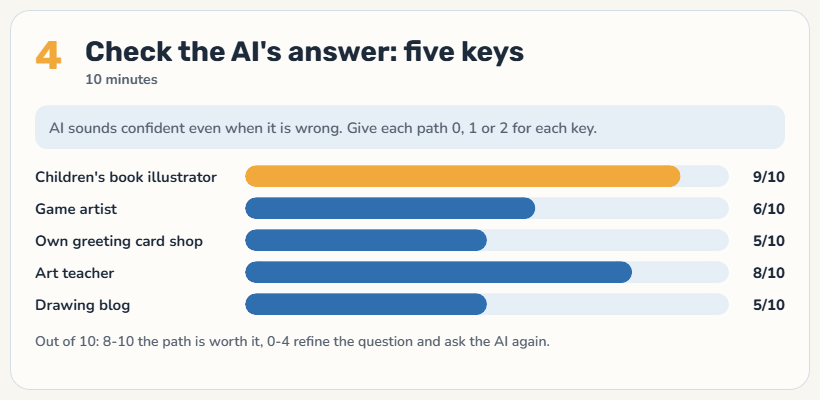
Example from the workbook, sample data.
The points don't decide for the child. They help the child explain why one path feels closer.
I made it in Claude, it took about ten minutes. But I work with AI every day, so the first time it will take longer. I'm not a designer or a programmer. I just knew what I wanted to get.
And a story about checking. That same day, AI wrote a reply to my friend on my behalf: "I read your whole guide." I hadn't read the whole thing. I noticed before sending and fixed it. AI confidently wrote something untrue in my name. That's why I read everything that goes out to people myself.
Learning together with children
To be honest: I haven't done this with my own children on purpose. I tell them that AI helps me at work and show them the results. My younger one is more into his bike, tricks and friends for now. My older one already works and turns to AI when he needs to fill in some form. And that's fine: not every child is interested in this.
AI doesn't replace learning or talking with your child, at school or at home. The basics stay the basics. But now working with AI is added to them, and it's easier to learn together.
It's bad when AI does a child's homework for them. It's useful the other way round: when AI helps you think rather than thinking for you.
The rules matter. Claude is for 18+ only. ChatGPT is from 13, and under 18 only with a parent's permission. So in Claude the account is always the adult's, and in ChatGPT, with children under 13, the adult types and reads the answers. The child thinks, suggests and checks.
If your child is interested, here is what you can try at home. In each case, the child sets the task and checks the answer:
- Cook dinner together. The child says what's in the fridge, how many people and how much time you have, and you ask for a recipe together. Then you check together: do you have everything, and did it turn out as the AI promised.
- Plan a weekend or a trip. The child sets the task using the four questions, and you check prices and opening hours on the real websites together.
- Talk through "what I want to be". The child first names 2-3 paths, then the AI suggests its own, and the child scores all of them and explains why.
There's no "adult who knows everything" here. The parent learns together with the child. And the phrase "I don't know either, let's figure it out together" often works better than any lecture.
Children will decide for themselves anyway. I think our job is to give them a skill that will be useful whoever they become.
What to do tomorrow
Take one task for the evening, ideally with your child: dinner, a trip, a present for grandma. Fill in the template and give it to the AI. These are the same four questions plus three lines I add for serious tasks: where to take it from, what not to do, where to stop.
Task: ...
Who it's for: ...
How it should work: ...
What the output should be: ...
Where to take it from: (files, links, examples)
What not to do: ...
Where to stop: (what to ask me before going further)
Before you start, tell me how you understood me, and ask questions if anything is missing.
Then check the answer together. Where did the AI go wrong? What would you ask differently?
Jobs will keep changing. The ability to explain a task and check the result will stay.
Maybe I'm wrong about something. Let's discuss it: write to me.
Service rules and setting names checked against their help pages in October 2026.